Open Courseware · Free to read

Open Courseware

Full course books from Dr. Okolie's chemical engineering classes at Bucknell University, free for anyone, anywhere. No sign-in, no paywall, no tuition: just the material, the way his own students use it.

Our stance

Knowledge should be open to everyone

Dr. Okolie is writing every course he teaches as an open book. The notes, workbooks and practice problems that Bucknell students use each week are published on the open web, so a student in Lewisburg, Lagos or Saskatoon can learn from exactly the same material.

It continues a long commitment to open teaching resources. He built his Introduction to Design of Experiments for Engineers course and his Computer-Aided Chemical Engineering lectures as open-source courses, co-wrote the openly licensed textbook Introduction to Process Simulation with Aspen Plus, and develops free learning tools such as the TEEAP and JQUIZZ apps.

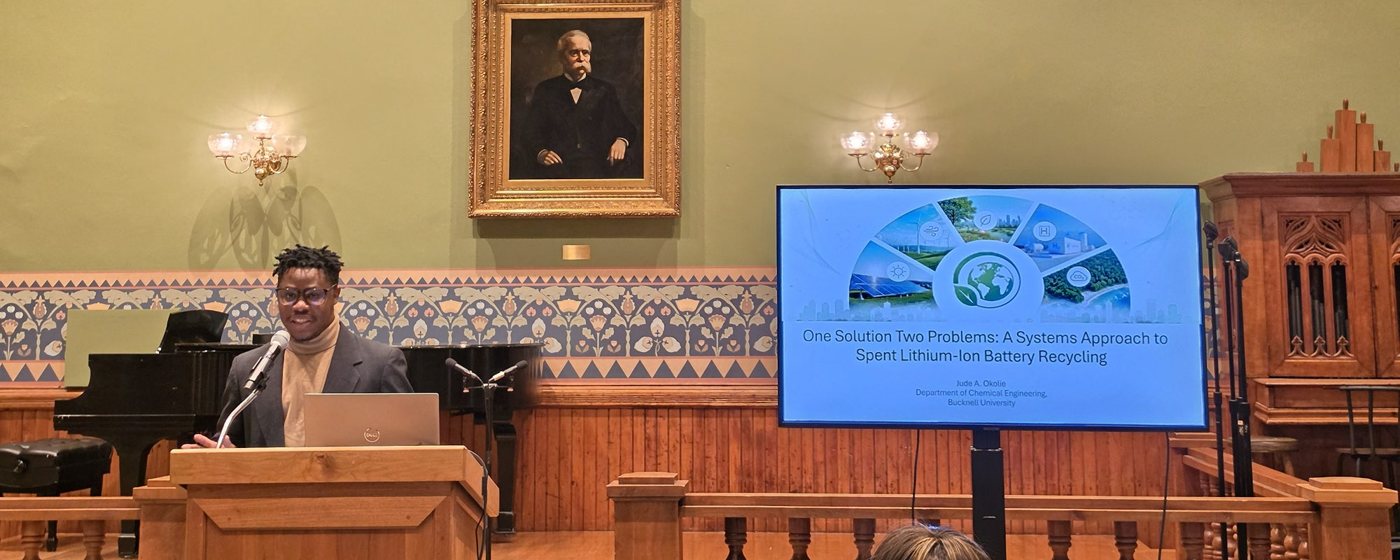
Dr. Okolie speaking at a lectern at Bucknell University
Dr. Okolie presenting a faculty colloquium at Bucknell University, November 2026.
01Free for everyone

No accounts, fees or paywalls. The books open on a phone, a laptop or a library computer, anywhere in the world.

02The whole course, not a sample

Learning objectives, module notes, workbooks, formula sheets and study steps, laid out week by week exactly as Bucknell students use them.

03Learn at your own pace

Self-directed modules let every student move at their own speed, revisit a topic before an exam, or catch up after a missed class.

04Open to teachers too

Instructors are welcome to point their students to these books. If you would like to adapt material for your own course, please get in touch.

The bookshelf

Course books

Each book follows the course week by week. Open a book to start at the welcome page, or jump straight to any module from its contents.

ENGR 233Chemical Engineering Fluid MechanicsDr. Jude A. Okolie · Bucknell University
ENGR 233 · Spring 2027

Chemical Engineering Fluid Mechanics

“Every chemical plant is, at heart, a network of fluids on the move.”

The course moves from fluids at rest to fluids in motion: hydrostatics, Bernoulli and mechanical-energy balances, pipe friction, pumps, momentum balances, dimensional analysis and non-Newtonian flow.

  • 10 modules
  • Lecture slides & workbooks
  • Formula sheet
  • Self-check on every module
  • Self-learning guides
All 10 modules
  1. Introduction to Fluid Mechanics and Fluid Properties
  2. Fluid Statics and Mass Balances
  3. Bernoulli Equation and Mechanical Energy Balance
  4. Bernoulli Applications and Flow Measurement
  5. Laminar and Turbulent Flow
  6. Pipe Friction and Pressure Drop
  7. Piping Systems, Minor Losses and Pumps
  8. Momentum Balances
  9. Applications of Momentum Balances
  10. Dimensional Analysis and Special Fluid Flows

Textbook: Noel de Nevers, Fluid Mechanics for Chemical Engineers, 3rd ed.
CHEG 210Applied Mathematics for Chemical EngineersDr. Jude A. Okolie · Bucknell University
CHEG 210 · Spring 2026

Applied Mathematics for Chemical Engineers

“Almost everything a chemical engineer models changes with time or position.”

From cooling reactors and draining tanks to heat spreading through a wall, the course covers first- and second-order ordinary differential equations, numerical methods, Laplace transforms, power series, matrices and eigenvalues, and an introduction to partial differential equations.

  • 13 weekly modules
  • Workbooks
  • Video lectures
  • Tests & exams page
All 13 modules
  1. Introduction to Differential Equations
  2. First-Order Equations: Integrating Factors and Separable Equations
  3. Exact Equations and Integrating Factors
  4. Numerical Methods for First-Order Equations
  5. Second-Order Linear Homogeneous Equations
  6. Second-Order Theorems and the Method of Undetermined Coefficients
  7. Variation of Parameters
  8. The Laplace Transform
  9. Solving Initial Value Problems with Laplace Transforms
  10. Series Solutions of Second-Order Equations
  11. Systems of First-Order Equations and Matrices
  12. Eigenvalues and the Eigenvector Method
  13. Review of Systems, Partial Differential Equations and Fourier Series

Texts: Boyce & DiPrima; Rice, Do & Maneval.

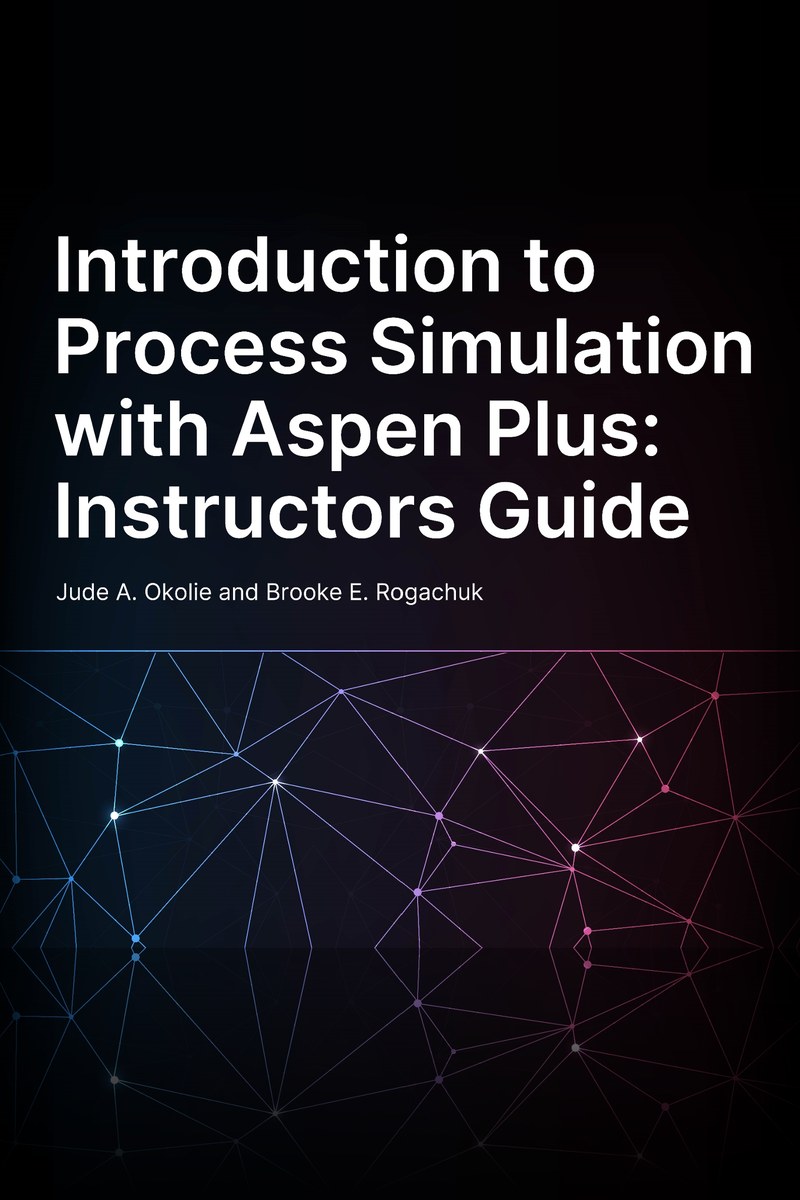
Cover of Introduction to Process Simulation with Aspen Plus: Instructor's Guide
Open textbook · CC BY-NC-SA 4.0

Introduction to Process Simulation with Aspen Plus: Instructor's Guide

Jude A. Okolie and Brooke E. Rogachuk, University of Oklahoma, 2024. An introduction to process simulation with Aspen Plus for chemical, environmental and process engineering students working on capstone design projects, covering process design fundamentals through practical examples. It was used in ENGR 3440 at the University of Oklahoma and is free to download, share and adapt for non-commercial use.

On the writing desk

More books on the way

Every Bucknell course Dr. Okolie teaches is being turned into an open book. Next up:

Material ScienceIn preparation
Sustainable Energy SystemsIn preparation
Data Science for Chemical EngineersIn preparation
Data Science for Engineering DesignIn preparation

Learning or teaching with these books?

Found a typo, solved a problem a smarter way, or want to use a module in your own class? Dr. Okolie would love to hear from you. For more free tools, see the learning apps and games on the Outreach page.