Puzzle Corner

How to solve a 4×4 cube

The reduction method: build the centres, pair the edges, and you're left with a big 3×3. Learn the 3×3 first.

Notation

Reading the moves

Each letter is one turn of one face. "Clockwise" always means clockwise as if you were looking straight at that face. Hold the cube the way each step says, and keep it in that position while you do a sequence.

RRight face clockwise
LLeft face clockwise
UUp (top) face clockwise
DDown (bottom) face clockwise
FFront face clockwise
BBack face clockwise
R'A prime (') means counter-clockwise
R2A 2 means a half turn (180°)
RwWide turn: the right face and the slice next to it together
rOnly the inner slice next to the right face
Uw, uSame idea for the top: two layers, or the inner slice only
xTurn the whole cube the same way as R
Step 1

Solve the centres

Each face of a 4×4 has a 2×2 block of centre pieces that can move around. First solve the white centre: pair two white centre pieces into a 1×2 bar, pair the other two, then bring the bars together. Next solve the yellow centre on the opposite face. Moves like Rw U Rw' lift pieces in and out without disturbing the bottom centre.

Then turn the cube so white and yellow are on the left and right. The other four centres (green, red, blue, orange) can now be built with r, r', U, F, D and B turns, which never touch the left and right centres. Short moves such as r U r' and r U2 r' move a bar between the top and front centres. Make sure the four go in the right order around the cube: green, red, blue, orange (with white on top, green in front, red is on the right).
Goal: all six centres solved
Step 2

Pair up the edges

Each 3×3 edge becomes two edge pieces on a 4×4, so you pair the 24 pieces into 12 "dedges". Outer-layer turns (R, U, F and so on) never break up centres or finished pairs, so use them freely to set up.

Hold white on top. Find two matching edge pieces and put them both in the upper of the two middle rows: one on the left edge of the front face, one on the right edge, both showing the same colour on the front. Then do:

Uw' R U R' F R' F' R Uw

The pair is now finished at the front-right. Move it into the top or bottom layer with outer turns and repeat. If the piece on the right shows the wrong colour on the front, R U R' F R' F' R flips the front-right edge in place. For the final two edges, the same algorithm finishes both at once when the lower halves match too.

Goal: centres solved and every edge paired
Step 3

Solve it like a 3×3

Now treat each 2×2 centre as one centre and each pair as one edge, and follow the 3×3 tutorial using outer-layer turns only. Two situations that a 3×3 can't have may appear at the end. They're called parity, and each has its own fix below.

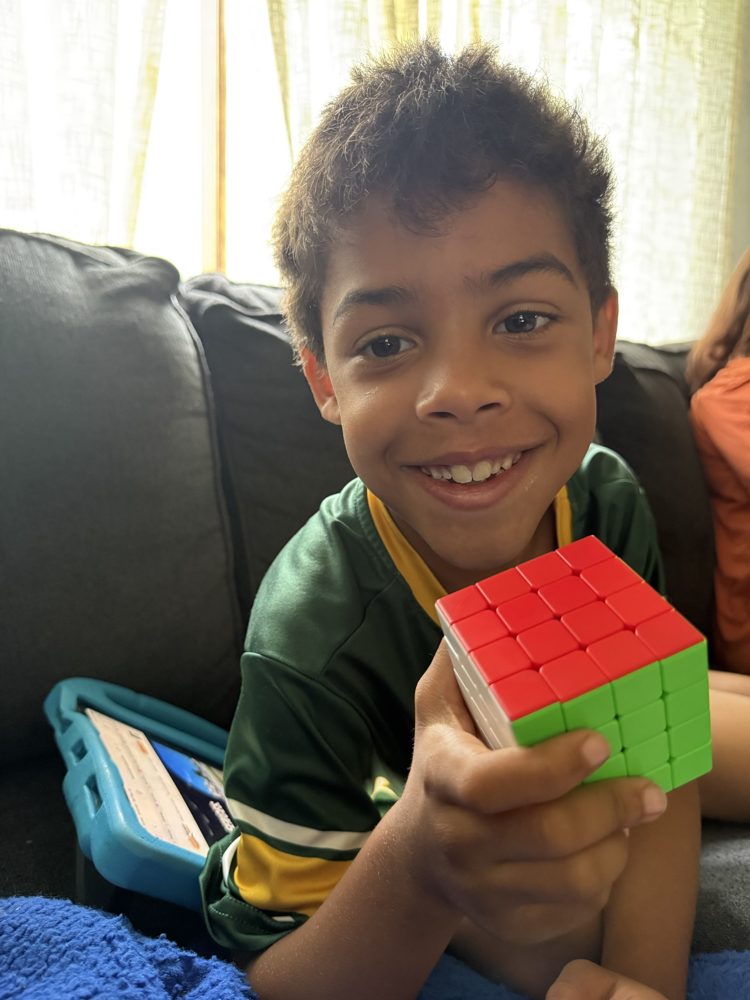
A young cuber holding up a solved 4×4 cube
Solved!
Step 4

Fix OLL parity: one flipped edge

While making the yellow cross, you might find a single edge flipped (an odd number of yellow edges point up, so you can never make the cross). Hold the flipped edge at the front of the top layer and do:

r2 B2 U2 l U2 r' U2 r U2 F2 r F2 l' B2 r2

In this algorithm r and l turn only the inner slice. Then carry on with the yellow cross.

OLL parity: the front edge is flipped
Step 5

Fix PLL parity: two edges swapped

At the very end you may find two opposite edges in the top layer swapped, with everything else solved. Hold them at the front and back and do:

r2 U2 r2 Uw2 r2 u2

Here r2 turns only the inner right slice, Uw2 the top two layers, and u2 only the inner top slice.

PLL parity: front and back edges swapped

Want a hand?

Dr. Okolie offers personalised tutorials, and can send you a cube to practise on. Tell us which puzzle you are learning and where you are stuck.